
Science That Redefines Pain Care
Relevium Medical combines evidence-based pharmacology and biomaterials to create targeted prodrug therapeutics designed for long-lasting relief and improved outcomes for chronic pain conditions

TRPV1 and Pain
THE TARGET
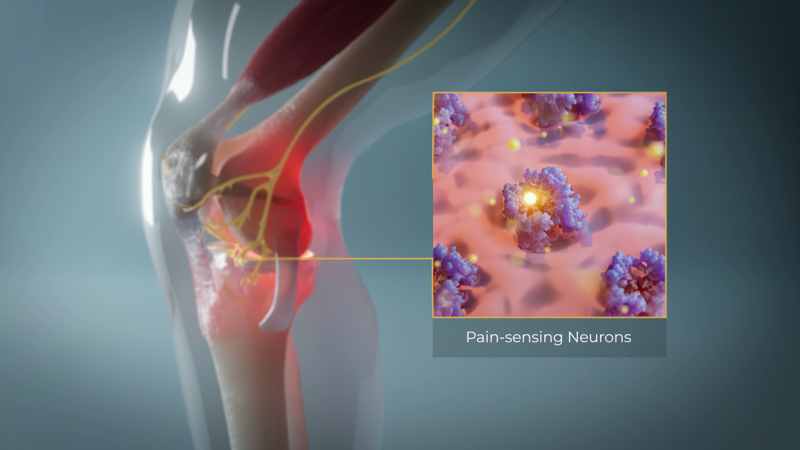
Chronic pain often persists not because tissue damage continues, but because the nerve fibers carrying pain signals become hyperexcitable. The TRPV1 ion channel, expressed on sensory nerve fibers, plays a central role in this pathological process: in conditions such as osteoarthritis, TRPV1 becomes overactivated. The result: nerve fibers fire at a lower threshold, amplifying pain signaling.
TRPV1 is one of the most well-validated targets for peripheral hyperexcitability disorders, including chronic pain, with extensive clinical and preclinical evidence supporting its use. Because TRPV1 is localized to peripheral nerve fibers rather than the central nervous system, targeting it directly offers the potential for site-specific relief without the systemic side effects of many oral analgesics.
The Problem
Despite being recognized as a clinically validated approach to pain relief for decades, TRPV1 agonists have been held back by one key problem: tolerability.
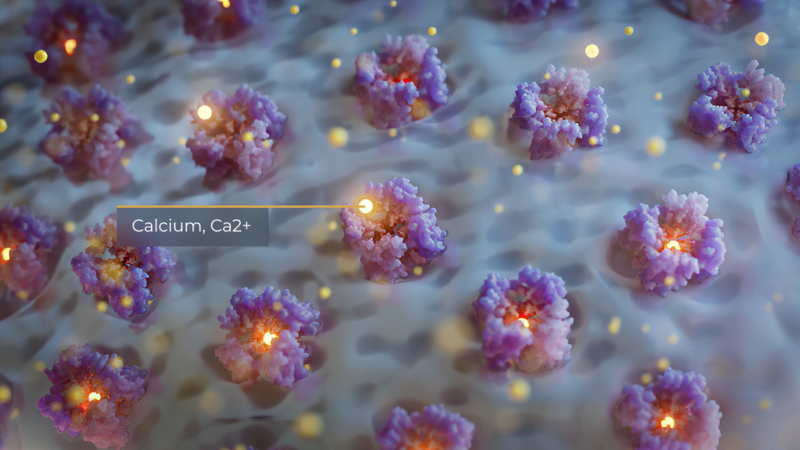
Activating TRPV1 initially triggers the same sensory nerve fibers that it is meant to desensitize and ablate, producing a severe burning sensation during and after administration – an intense discomfort for many patients. This tolerability problem:
• Limited acceptance and adherence for patients
• Limited adequate drug dosing for durable effects
• Resulted in high patient dropout rates from trials
• Required elaborate administration protocols – a burden for providers

RM-010: A Targeted, Multi-Pipeline Prodrug Strategy
OUR SOLUTION

At Relevium, our science starts with a fundamental principle:
Treat the pain at its source, safely and effectively.
Our lead therapeutic candidate, RM-010, is developed exactly for this without the TRPV1 tolerability burden.
We leveraged naturally occurring biopolymers to design RM-010, a novel TRPV1 prodrug in which the active agent is bonded through linkages tailored for controlled kinetic release. These chemical bonds are engineered to cleave gradually over 24 hours, releasing the active precisely where it's needed – without any high-intensity nerve activation and therefore no burning sensation. Pain signaling is silenced at the source, providing relief for months.
How RM-010 Works
BREAKTHROUGH
RM-010 is our lead therapeutic, formulated for intra-articular injection to address knee osteoarthritis pain. Its design focuses on sustained pain relief while providing joint lubrication and minimizing local and systemic side effects.

Key Advantages:
No dose ceiling: adequate dosing and greater residency time at the target site enables more effective ablation and superior relief than conventional TRPV1 agonist therapies.
No extended in-clinic management: can be delivered in the same procedure time as a routine hyaluronic acid or steroid injection, with none of the monitoring burden required by earlier TRPV1 agonists.
No systemic side effects: a localised, highly selective mechanism avoids the systemic effects commonly associated with opioids.
RM-010 has the potential to be extended in use for other joints affected by OA
Supported By Experts
Dr Edna Venneker
“From my analysis of clinical and translational data, capsaicin remains one of the most compelling pain therapeutics. By selectively targeting TRPV1-positive sensory nerve fibres, it can provide prolonged analgesia while minimising systemic side effects.”
Former Head of Development and Senior Vice President at Grünenthal


Professor David Hunter
“Based on my analysis of the clinical trial data on Capsaicin for Knee OA pain, I think the RM-010 program is definitely worth pursuing.”
Ranked the world’s leading osteoarthritis expert on Expertscape.


Dr Nathaniel Katz
“Capsaicin has proven effective across pain indications, including positive studies in Knee OA, as well as a good safety profile, making this a promising analgesic.”
Globally recognised expert in pain management and founder of Analgesic Solutions, acquired by WCG.


Dr Diana Meske
“Based on the clinical data, I have no doubt that Capsaicin is an effective analgesic for Knee OA pain with an extremely clean safety profile.”
Former Clinical Director


Prof Peter Schmidt
“Relevium’s approach to osteoarthritis pain has the potential to revolutionize how we, as clinicians, treat this disabling condition”
Leading Pain Specialist.


RESEARCH & PRECLINICAL EVIDENCE
Driven by Evidence
Our platform and lead candidate have been developed through rigorous preclinical research, including advanced pain models and biomolecular analysis. This evidence supports our belief that targeted prodrug delivery can significantly improve pain outcomes compared to existing therapies.
Key preclinical work demonstrates safety and efficacy in relevant disease models, forming a strong foundation for clinical progression.